Self-generated hydrogel ejects bacterial cells for localized biofilm dispersion
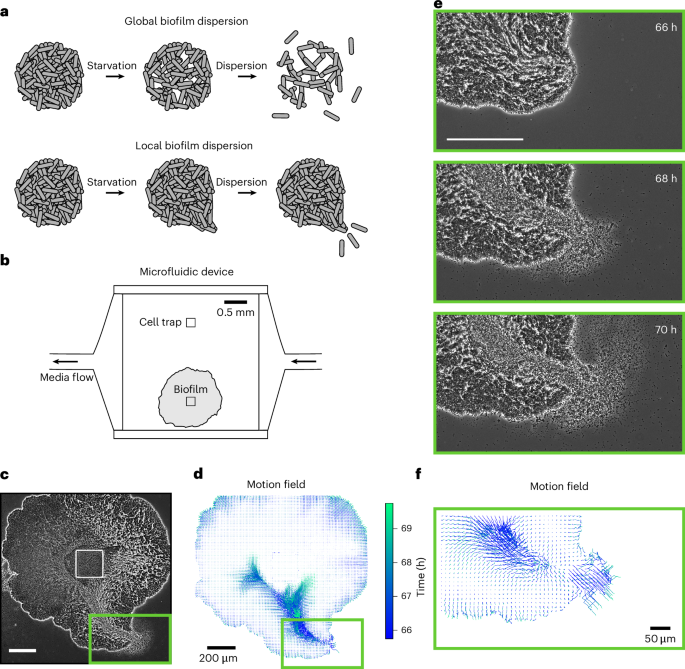
Bacteria residing in biofilms are embedded in an extracellular matrix. Whereas biofilm formation is well studied, less is known about biofilm dispersion, although enzymatic extracellular matrix degradation is suspected to play a key role. Here we show that Bacillus subtilis biofilms can alternatively eject a specific cell type, locally and anisotropically, using mechanical forces arising from a self-generated hydrogel. Single-cell resolution imaging combined with mathematical modelling, and chemical and genetic perturbations, show that the production of the extracellular poly-γ-glutamic acid (γ-PGA) polymer is necessary to drive this cell ejection. Specifically, osmotic pressure from the γ-PGA hydrogel propels interior cells through the outer layers to break free from the biofilm. We demonstrate control over this process through γ-PGA modulation such that biofilm dispersion can be either inhibited or promoted. Forceful ejection driven by γ-PGA has so far only been described in marine organisms such as jellyfish. Our discovery of biofilm cell ejection via γ-PGA thus reveals not only a previously uncharacterized biofilm dispersion mechanism but also an unexpected mechanistic parallel to evolutionarily distant Cnidaria. Bacillus subtilis biofilms locally disperse by ejecting motile cells through osmotic pressure generated by their poly-γ-glutamic acid hydrogel, a mechanism resembling that through which Cnidaria eject nematocysts.